← gallery
NGC 2403 (Caldwell 7) · Spiral Galaxy
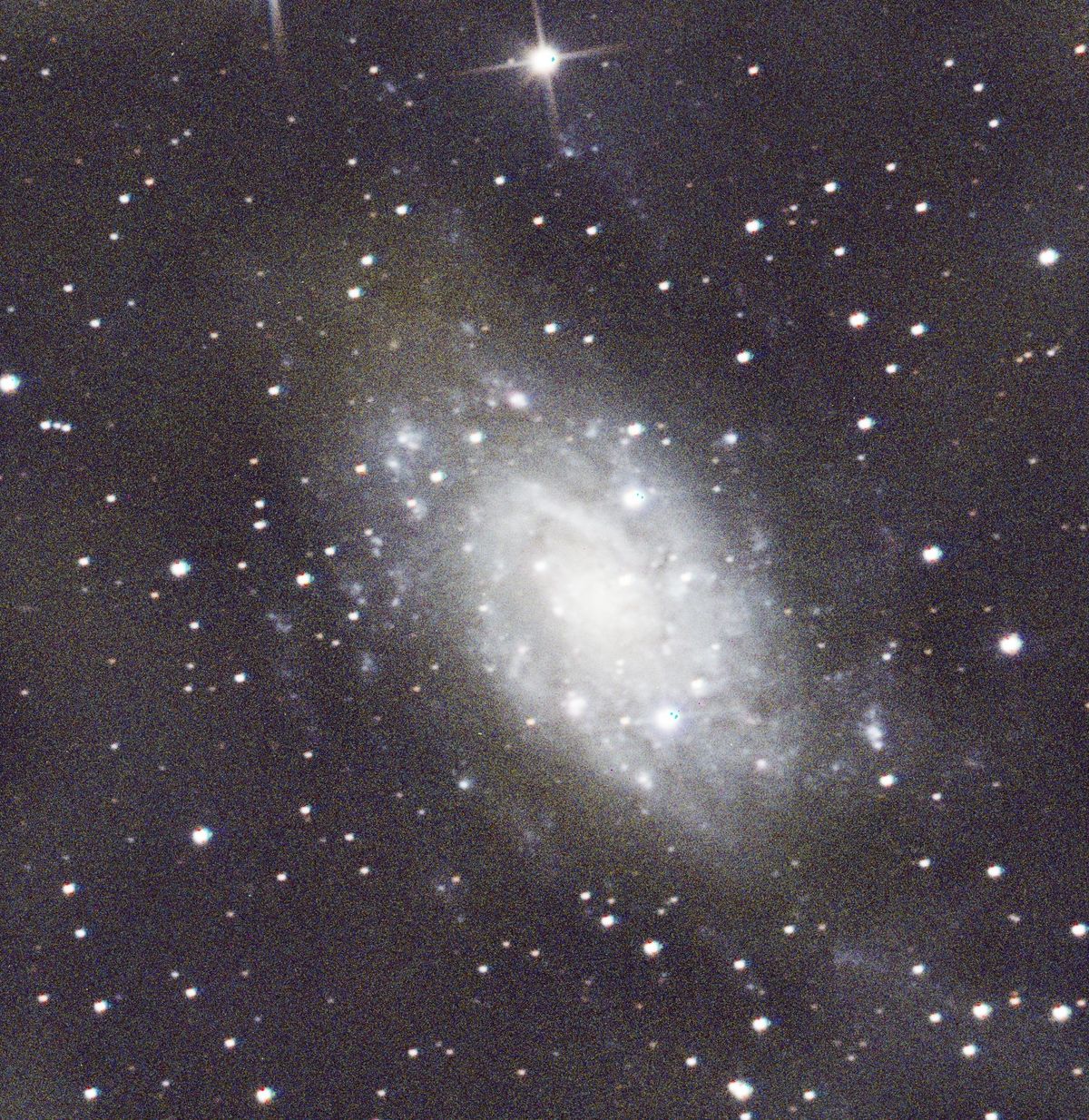
A bright, richly-detailed spiral galaxy in Camelopardalis, studded with glowing pink star-forming regions along its loosely-wound arms.
NGC 2403 is an intermediate spiral galaxy about 8 million light-years away, an outlying member of the M81 group. It was the first galaxy beyond our Local Group found to contain Cepheid variable stars, and it is famous for its unusually large and luminous H II regions — vast clouds of glowing hydrogen where new stars are forming, scattered like rubies along the spiral arms.
Discovered by William Herschel in 1788, it sits in the faint northern constellation Camelopardalis and rides high overhead from northern latitudes through the winter and spring. Its bright knots and clumpy, asymmetric arms make it a rewarding target for medium apertures.
This image was taken with a mono camera through LRGB and hydrogen-alpha filters on the 200 mm Newtonian, which picks out the pink HII complexes against the galaxy's blue spiral structure.
// imaging sessions
session // 01
21.04.2026 Mono LRGBHa — Explorer 200P + ATR533M
- Gear
- Sky-Watcher Explorer 200P Newtonian · TS-Optics 2" Newtonian coma corrector · ToupTek ATR533M · ToupTek motorized filter wheel (AFW / EFW) · Sky-Watcher EQ5 Pro SynScan GoTo · 50/90 mm guide / finder scope · ToupTek 327C Mini guide camera
- Filters / frames
- L, R, G, B, Ha
- Total integration
- 180 s subs
- Frames
- 180 s subs (LRGB + Ha)
- Sensor
- gain 100
- Software
- N.I.N.A. (Nighttime Imaging 'N' Astronomy) · Siril · GIMP · PHD2
Mono LRGBHa capture of NGC 2403 on 21 April 2026 with the ToupTek ATR533M behind the ToupTek filter wheel on the Explorer 200P Newtonian (1000 mm) + coma corrector, EQ5 Pro SynScan GoTo, PHD2 guiding via the 50/90 + 327C. 180 s subs at gain 100. Stacked in Siril, finished in GIMP. Background gradient and green cast cleaned in post.