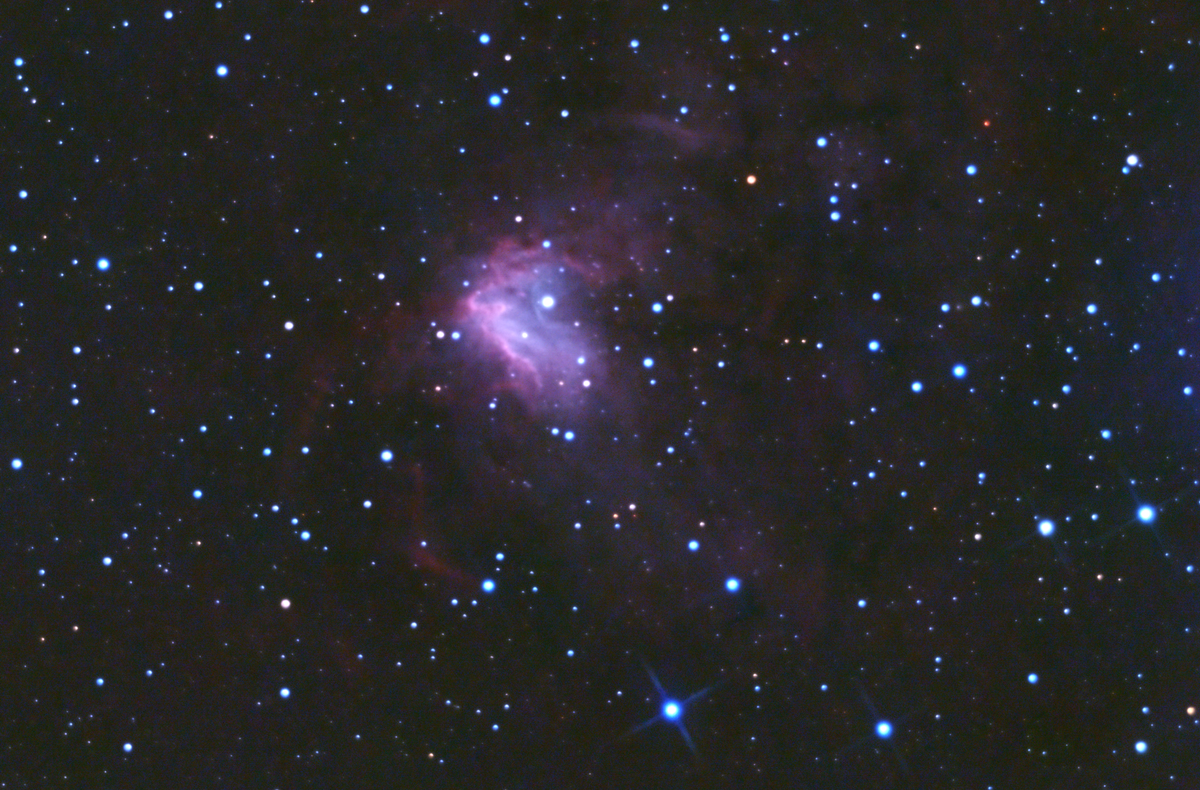
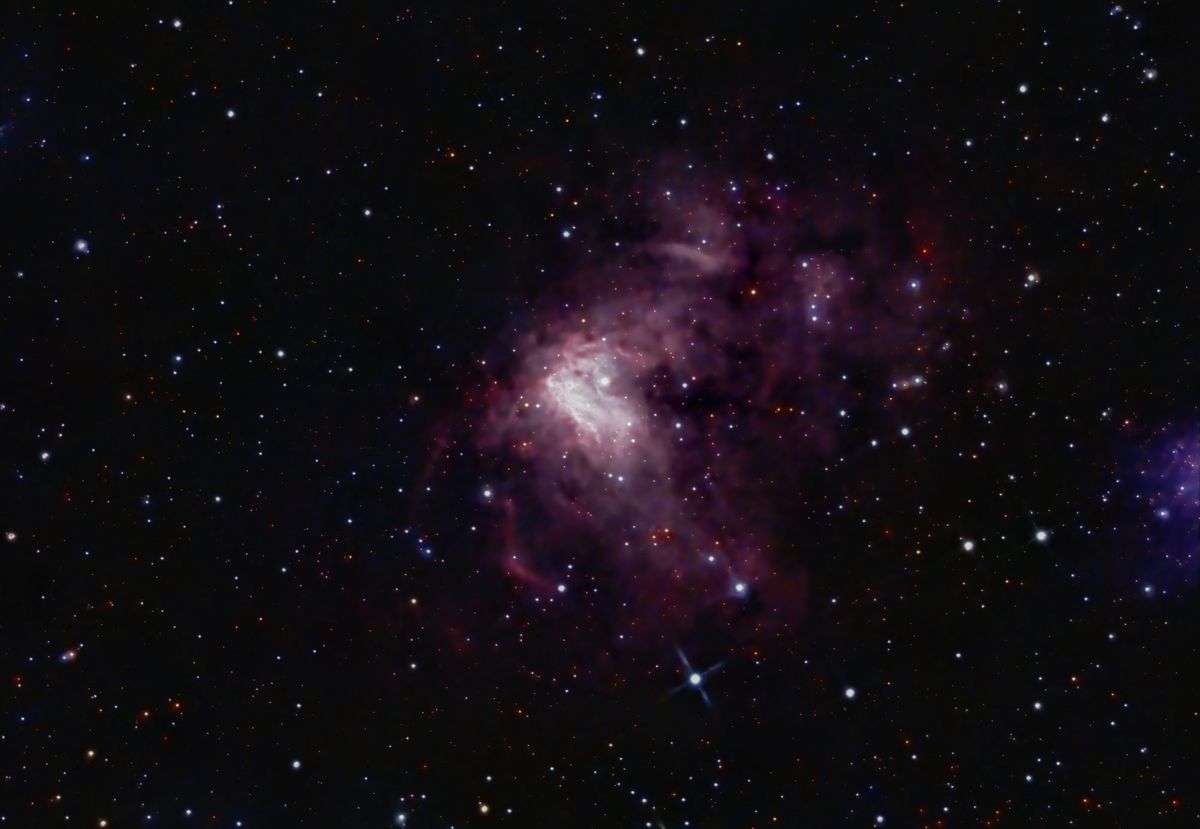
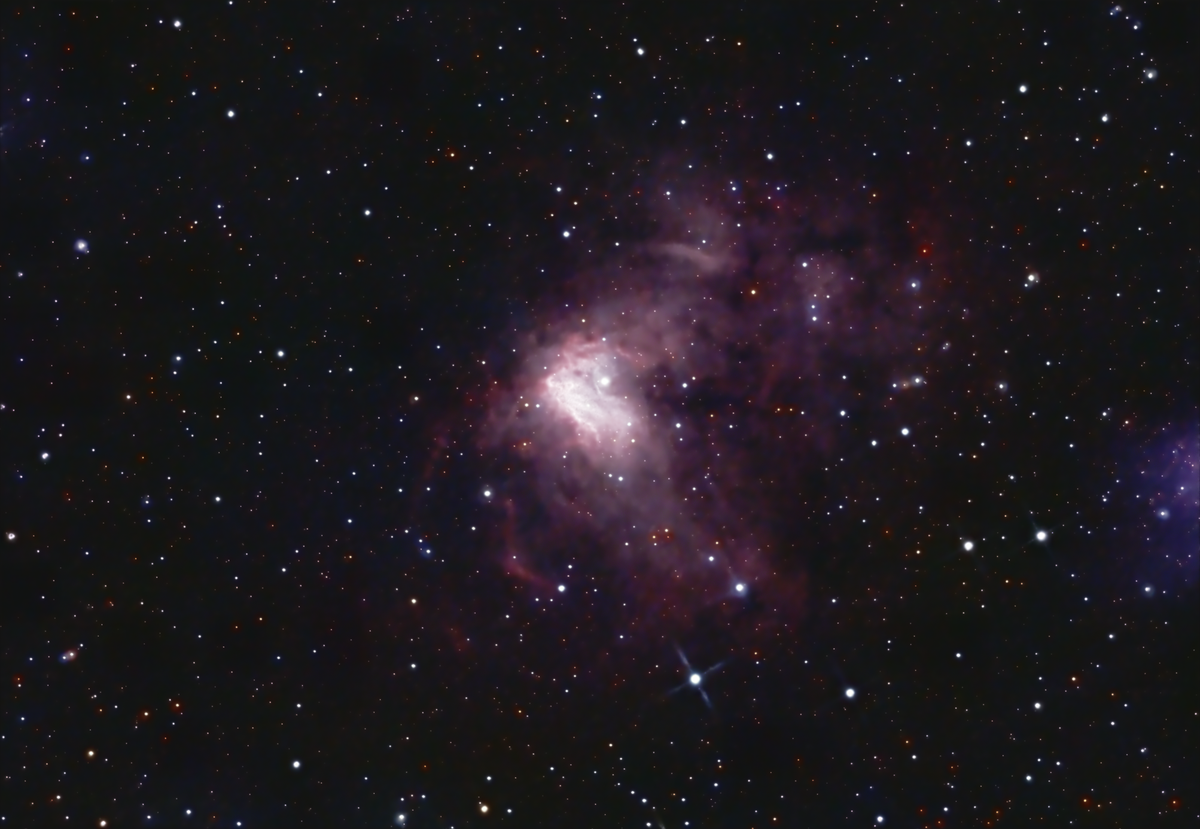
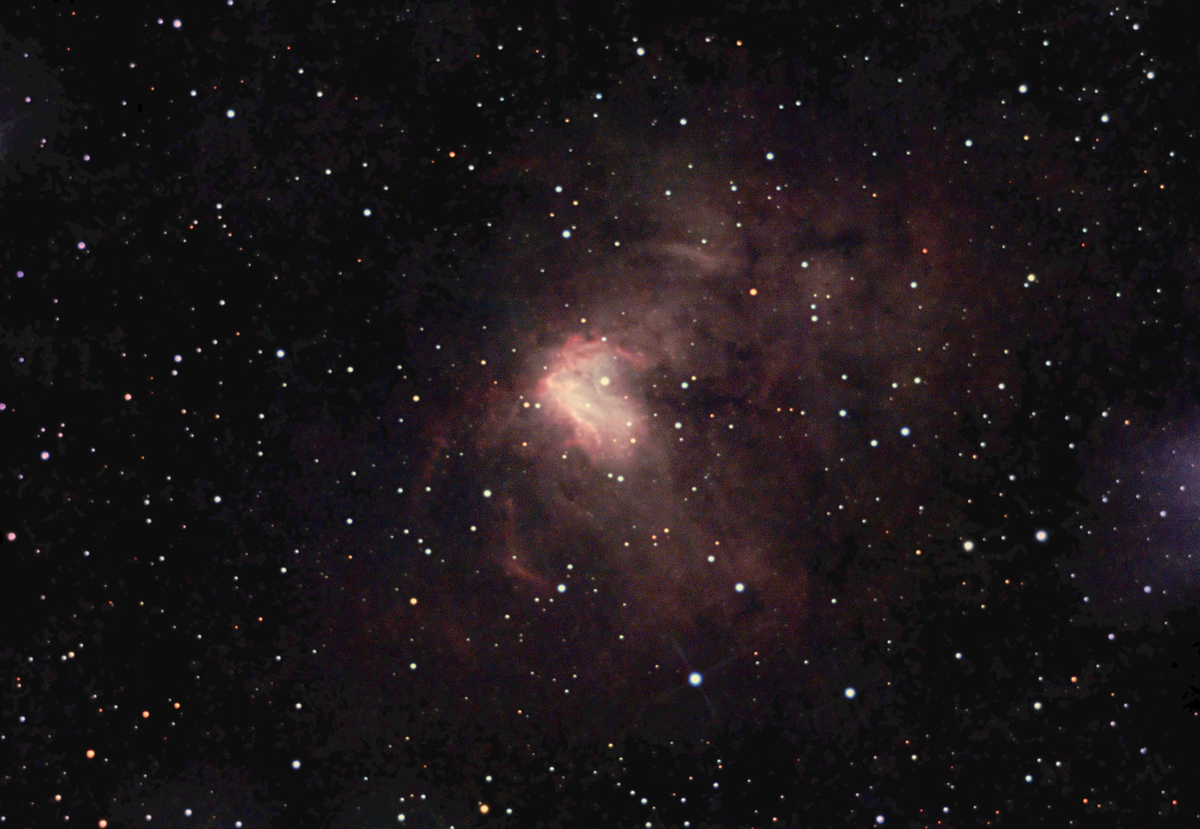
← gallery
NGC 1491 (Sh2-206) · Emission Nebula
Fossil Footprint Nebula
An HII region in Perseus carved by the ultraviolet wind of a single very hot O5-type star, BD+50° 886, sitting just off-centre inside its own glowing cocoon of hydrogen and oxygen.
NGC 1491 is a textbook example of how a single luminous early-type star can sculpt an entire region of interstellar gas. The ionising source — BD+50° 886, a hot O5 star — emits enough ultraviolet photons to strip electrons from the surrounding hydrogen, lighting up the cloud as a classic HII region. Where the stars wind smashes into the cooler ambient cloud, a curved ionisation front forms: that bright crescent edge is the most photogenic part of the nebula.
Its informal name — the Fossil Footprint Nebula — comes from the broad, asymmetric outline that, in deep exposures, suggests a single splayed footprint embedded in the dark Perseus background. Catalogued by Herschel in 1790 and later recorded as Sharpless 2-206, it sits about 10,700 light-years away.
For astrophotographers NGC 1491 responds beautifully to narrowband and dual-band filters. The Hα layer carries most of the structure — wind-blown filaments, the bright ionisation front, dark dust globules silhouetted against the glow — while OIII pulls out the more delicate halo around the central star and the wisps that drift to the west. Wide-field framings often include the faint glow of neighbouring HII regions; tight crops on the ionisation front itself reward long total integration.
// imaging sessions
session // 01
15.11.2025 OSC + dual-band Hα+OIII — 200P + 183CA from Plau am See
- Gear
- Sky-Watcher Explorer 200P Newtonian · Sky-Watcher EQ5 Pro SynScan GoTo · ToupTek 183CA · TS-Optics 2" Newtonian coma corrector · Pegasus Astro Gemini EAF · 50/90 mm guide / finder scope · ToupTek 327C Mini guide camera · ToupTek motorized filter wheel (AFW / EFW)
- Filters / frames
- 2" Hα + OIII dual-band
- Total integration
- ~4 h
- Sensor
- gain 100
- Location
- Klebe, Plau am See, Mecklenburg · Bortle 3
- Software
- N.I.N.A. (Nighttime Imaging 'N' Astronomy) · Siril · GIMP · PHD2
Mid-November Perseus session at Plau am See — OSC 183CA behind the 2" dual-band Hα + OIII filter at f/5. The ionisation front around BD+50° 886 came out cleanly; the surrounding cloud structure took a deeper stretch to recover. Capture date is approximate (mid Nov 2025); processed in two iterations on 23 Nov and 7 Dec.