← gallery
M76 (NGC 650 / NGC 651) · Planetary Nebula
Little Dumbbell Nebula
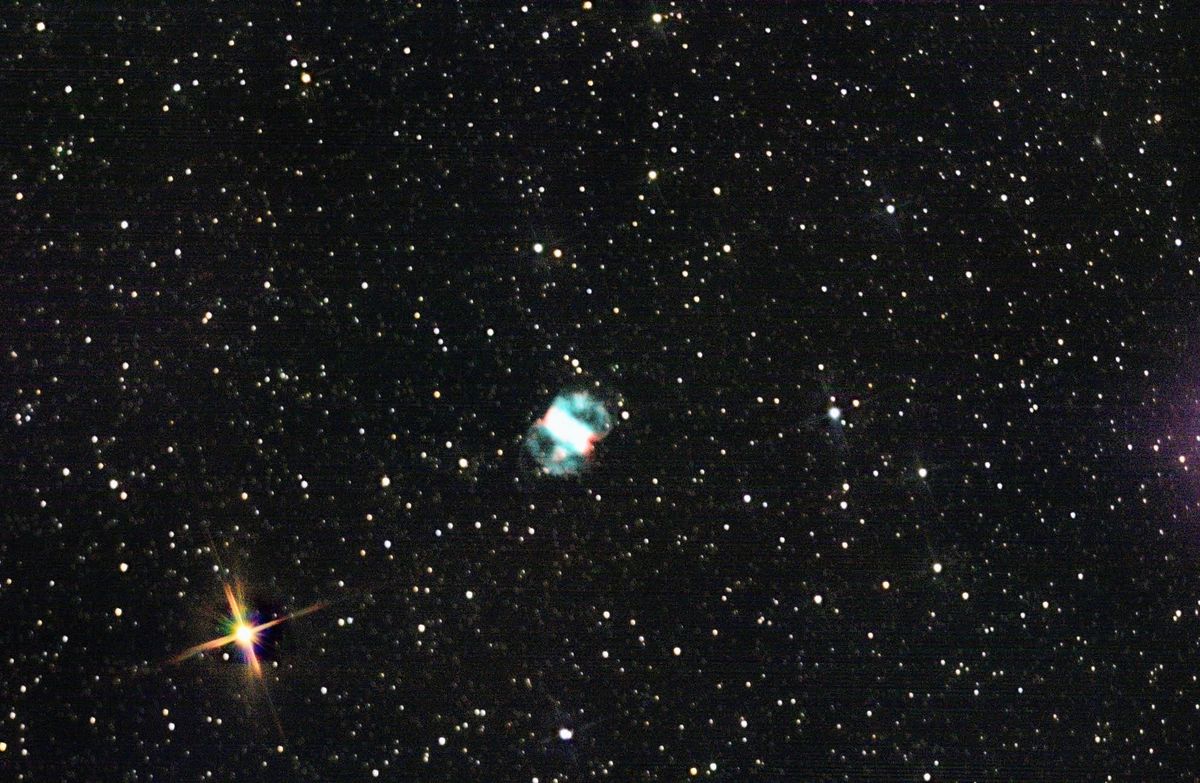
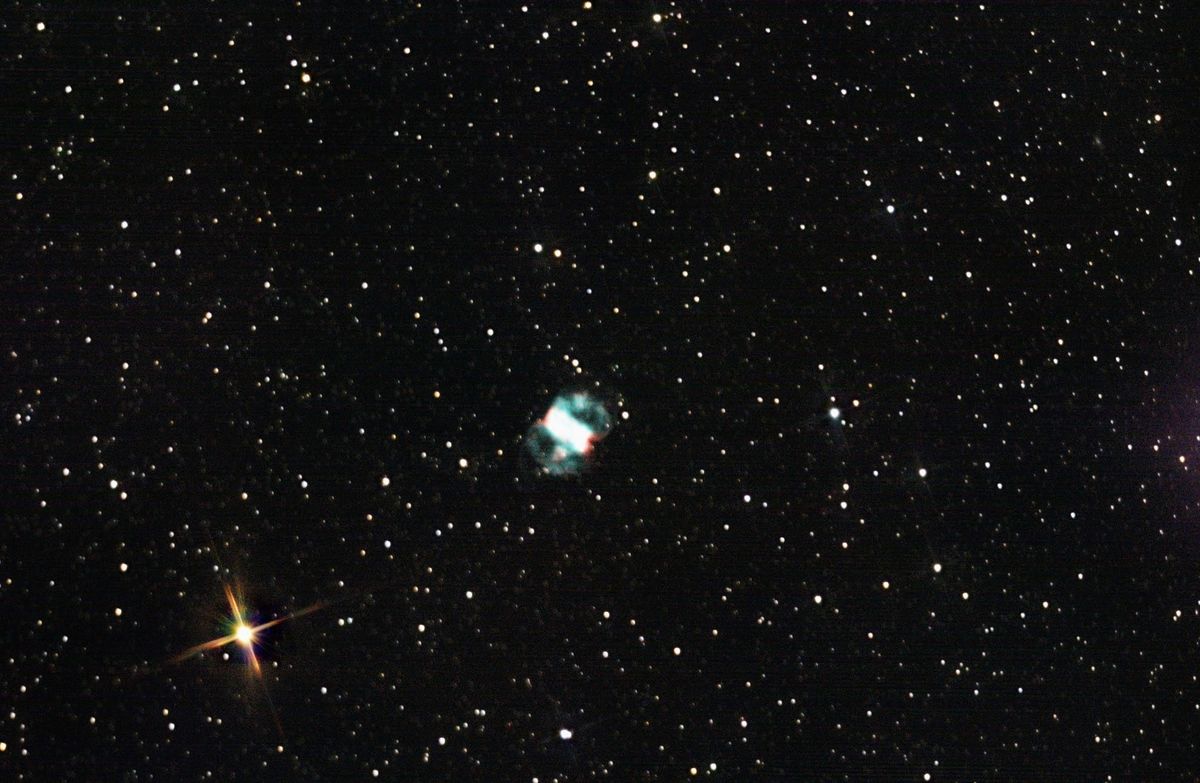
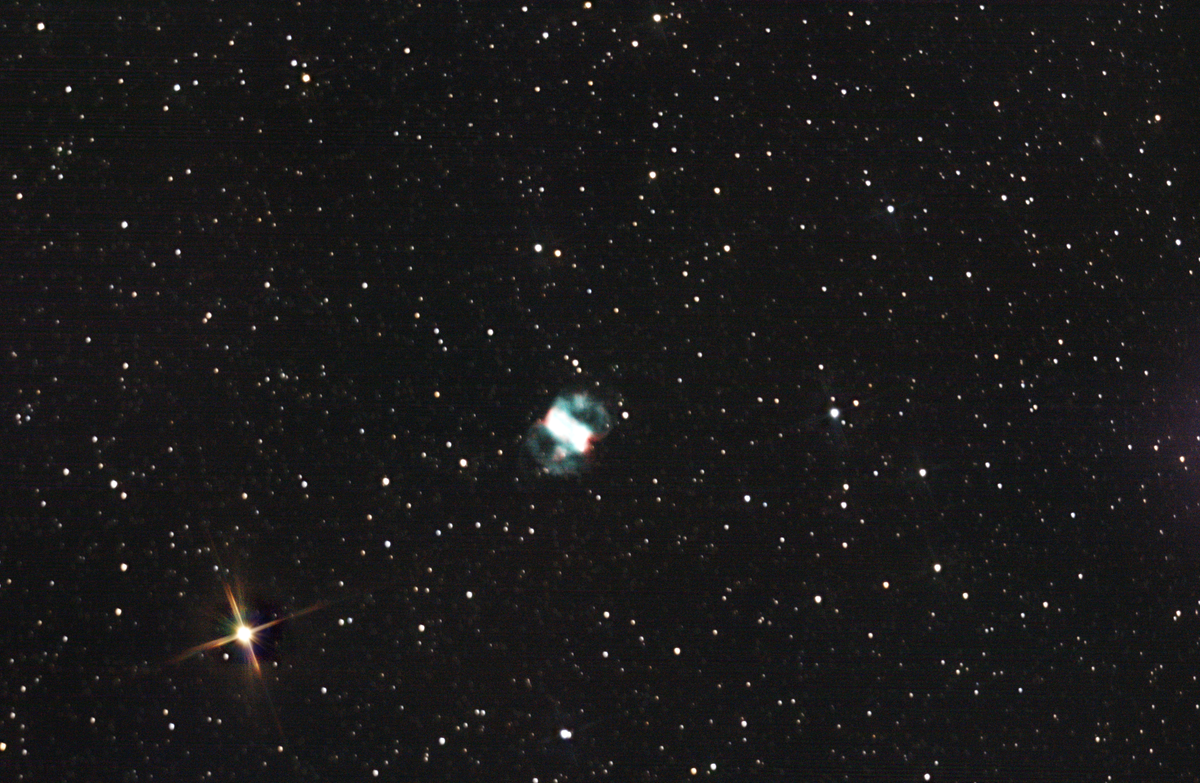
One of the smallest and faintest Messier objects — a bipolar planetary nebula in Perseus, with two prominent cyan-OIII lobes wrapped by a fainter pink Hα halo. Powered by a central white dwarf that is among the hottest stars known.
M76 looks at first glance like a miniature version of M27, the Dumbbell Nebula in Vulpecula — and the resemblance is exactly why amateur astronomers nicknamed it the Little Dumbbell (and also, depending on the catalogue, the Barbell, the Butterfly, or the Cork). What you see is the cast-off envelope of a Sun-like star that exhausted its nuclear fuel and shed its outer layers into space.
The two bright lobes are the dense waist of the bipolar outflow, glowing strongly in OIII (cyan-blue) and Hα (pink-red). The much fainter halo that extends beyond them — best captured with long total integration — is older material from earlier mass-loss episodes by the dying star. At the geometric centre lies the exposed white-dwarf core, with a surface temperature near 88,000 K — one of the hottest central stars of any known planetary nebula.
For astrophotographers M76 is a long-focal-length / narrowband target. Its small (under 3 arcminutes across) so it rewards a long-focus telescope and tight cropping. Dual-band and SHO palettes both work; broadband captures the lobes but miss most of the halo. Distance estimates have shifted considerably over the decades — modern Gaia-era values place it nearer than the older 3,400-ly figure, around 2,500 light-years.
// imaging sessions
session // 01
18.10.2025 OSC + dual-band Hα+OIII — 200P + 183CA from Plau am See
- Gear
- Sky-Watcher Explorer 200P Newtonian · Sky-Watcher EQ5 Pro SynScan GoTo · ToupTek 183CA · TS-Optics 2" Newtonian coma corrector · Pegasus Astro Gemini EAF · 50/90 mm guide / finder scope · ToupTek 327C Mini guide camera · ToupTek motorized filter wheel (AFW / EFW)
- Filters / frames
- 2" Hα + OIII dual-band
- Total integration
- ~4 h (14,280 s)
- Frames
- ~120 × 120 s
- Sensor
- gain 120
- Location
- Klebe, Plau am See, Mecklenburg · Bortle 3
- Software
- N.I.N.A. (Nighttime Imaging 'N' Astronomy) · Siril · GIMP · PHD2
October session at Plau am See — OSC behind the 2" dual-band Hα + OIII at f/5. M76 is small (~3′), so the framing is intentionally wide; the EDIT version recovers the faint outer halo around the bright bipolar core.