← gallery
M101 (NGC 5457) · Spiral Galaxy
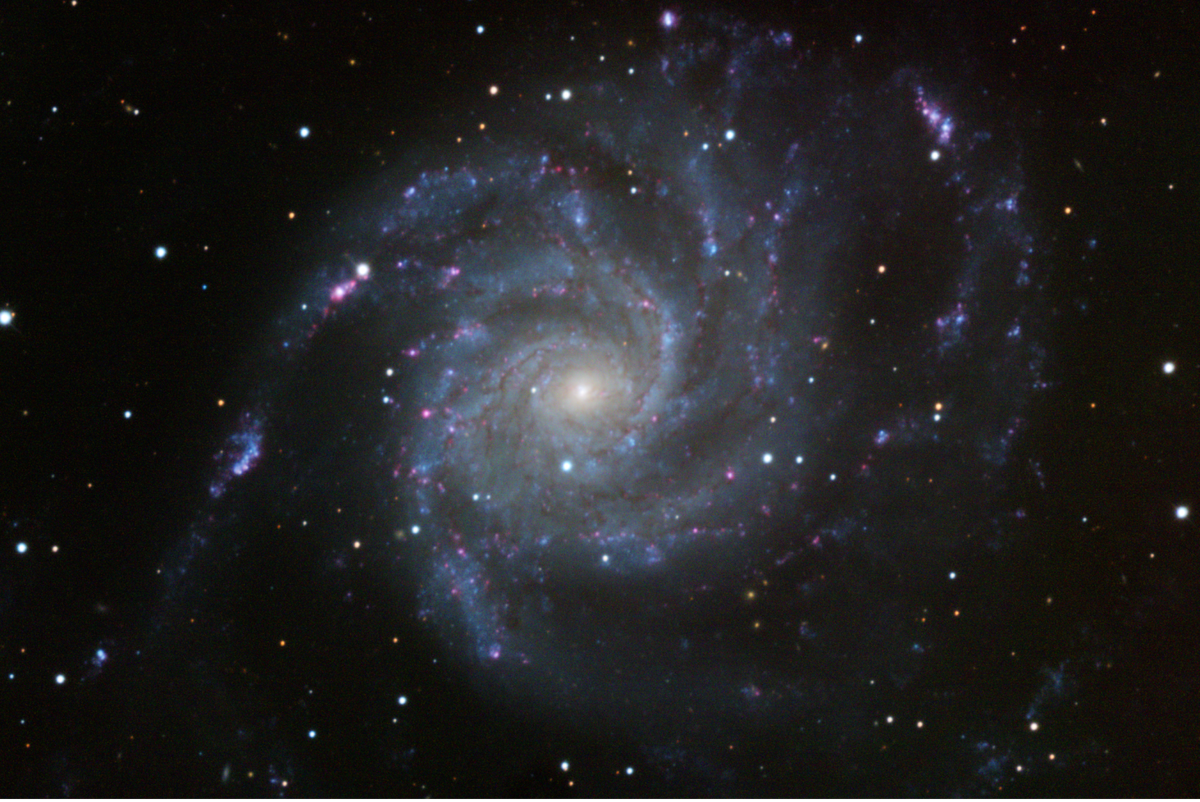
Pinwheel Galaxy
A nearly face-on spiral roughly 70% larger across than the Milky Way, with an asymmetric disc shaped by gravitational interactions with smaller companion galaxies. Its prominent HII regions are individually catalogued as NGC objects.
M101 lies in Ursa Major, off the handle of the Big Dipper, presenting one of the finest face-on views of a spiral galaxy available to amateurs. Its disc spans roughly 170,000 light-years — substantially larger than the Milky Way — and its arms are studded with so many star-forming regions that several have their own NGC catalogue numbers (NGC 5447, 5450, 5455, 5461, 5462, 5471).
The galaxy is not symmetric: the eastern arm extends much further than the western arm, almost certainly the result of past tidal encounters with its retinue of small companion galaxies including NGC 5474.
SN 2011fe — a Type Ia supernova that briefly reached magnitude 9.9 in late August 2011 — was discovered in M101 and became one of the best-studied 'standard candles' of its era because of how soon after first light it was detected. The galaxy's low surface brightness makes it a patience target for imagers; many hours of exposure are needed to recover the faint outer arms, but the reward is one of the most striking galaxy portraits available from a backyard setup.
// imaging sessions
session // 01
28.12.2025 – 15.03.2026 Mono LRGB + Hα — 200P + ATR533M from Plau am See (multi-night)
- Gear
- Sky-Watcher Explorer 200P Newtonian · Sky-Watcher EQ5 Pro SynScan GoTo · ToupTek ATR533M · TS-Optics 2" Newtonian coma corrector · Pegasus Astro Gemini EAF · 50/90 mm guide / finder scope · ToupTek 327C Mini guide camera · ToupTek motorized filter wheel (AFW / EFW)
- Filters / frames
- L, R, G, B, Hα (1.25")
- Total integration
- ~6 h
- Frames
- L ~1.5 h · R/G/B ~30 min each · Hα ~2.5 h
- Sensor
- gain 100 · -10°C
- Location
- Klebe, Plau am See, Mecklenburg · Bortle 3
- Software
- N.I.N.A. (Nighttime Imaging 'N' Astronomy) · Siril · GIMP · PHD2
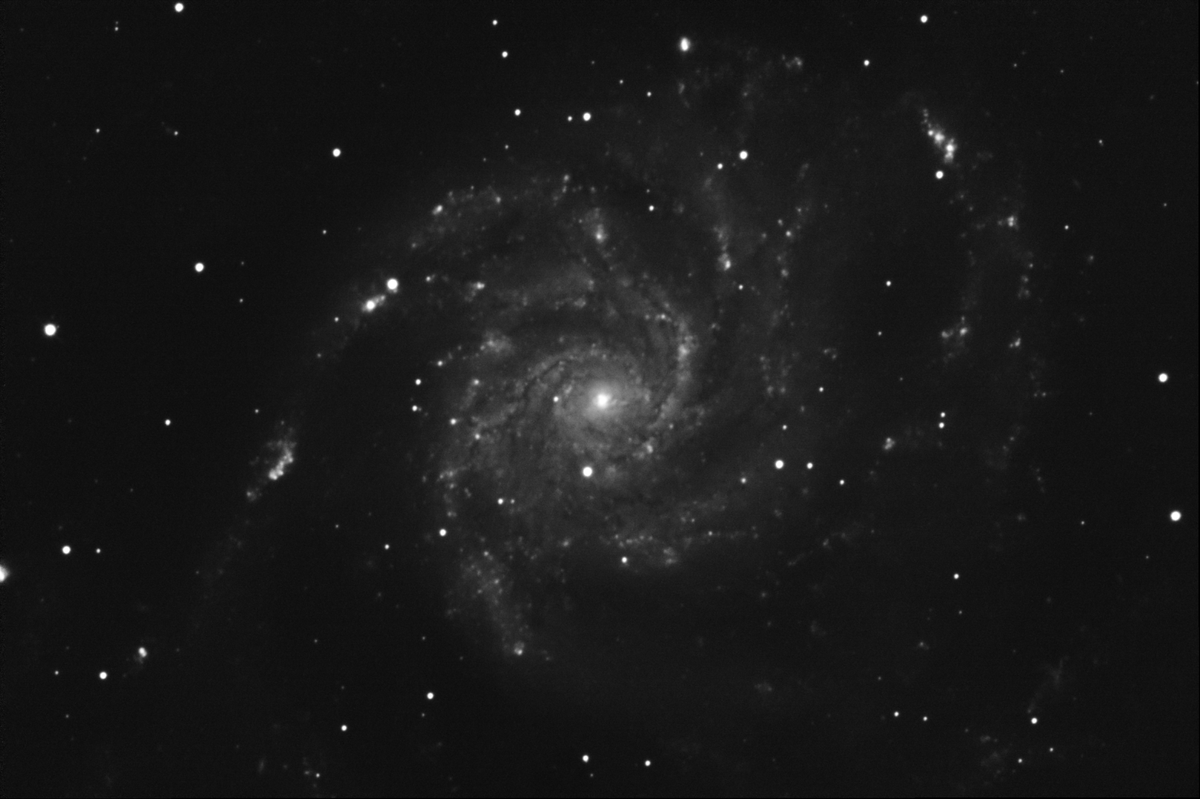
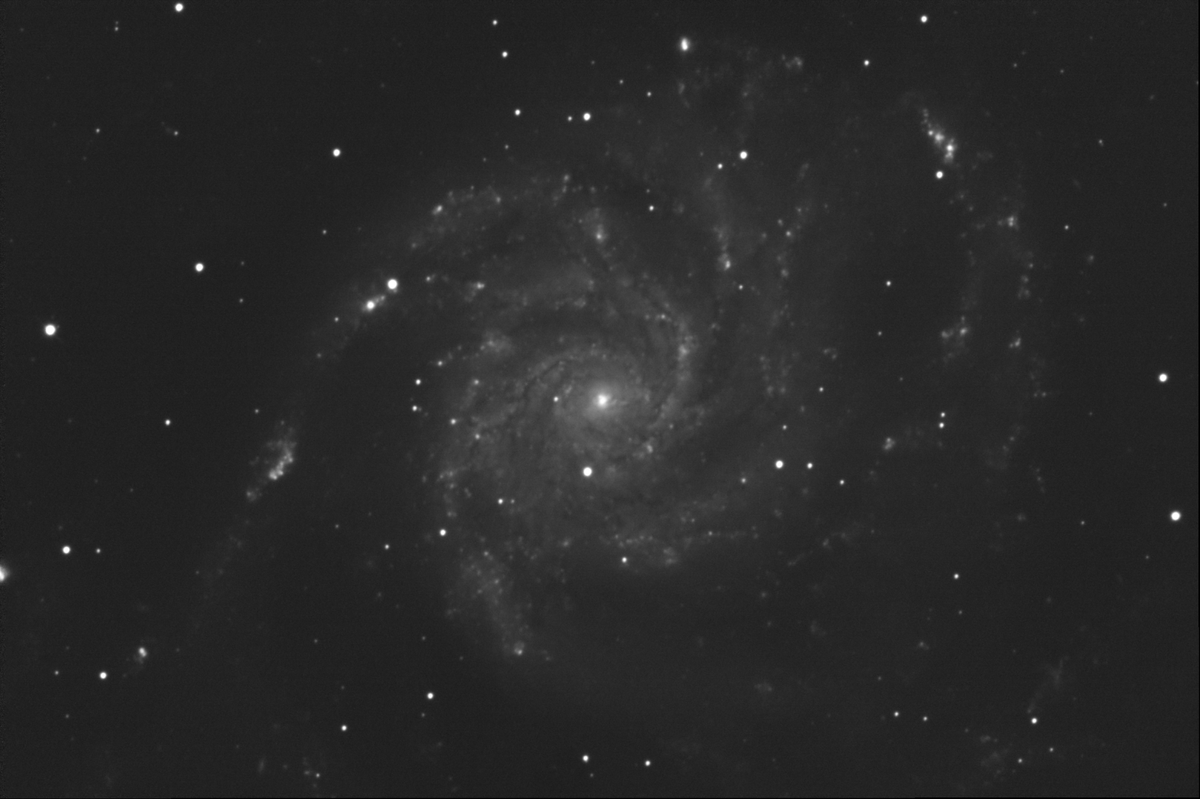
Mono campaign across two nights — December first light to capture L+RGB layers, then a deep Hα pass in March to extract the HII regions along the spiral arms (NGC 5471, 5447, 5462). PHD2 guiding via the 50/90 + 327C; autofocus per filter via the Pegasus EAF. Processed with Siril (calibration, stacking, photometric colour, deconvolution) and finished in GIMP.